Professor Derek Sayer Responds to My Letter

Please see Professor Sayer’s thoughtful response to my letter on his own blog. I will react to his comments here shortly. He wrote:

I welcome debate, and think Mr Labendz deserves an equally public response.  His concerns are serious ones.  But so were mine.

In the Preface to my book Capitalism and Modernity, dated 31 December 1989, I argued that Czechoslovakia’s Velvet Revolution “was not the sort of revolution to which the modern world is used.  It was, for once, a revolution against those ersatz gods of modernity who have stolen, by divine right of ideology, decades of people’s lives, hopes and dreams; a refusal of the reduction of the personal to the political.”  I went on to suggest that “we may be witnessing, in Eastern Europe, not the return of the prodigal to the fold of ‘the West’ hailed by politicians from Thatcher to Bush, but something quite new: a ‘post-modern’ revolution…”

Three months later I visited Czechoslovakia for the first time.  One episode in particular from that trip stuck in my mind.  I wrote about it later in Going Down for Air (2004):

It is early in 1990, that uncertain time between the Velvet Revolution and the first free elections in forty-two years.  At a loose end one evening I decide to take myself to the local opera house, where [Verdi’s] Nabucco happens to be playing.  Before the performance begins a man steps through the curtain to the front of the stage.  I expect to learn that one of the principals is indisposed.  Instead he makes a passionate plea on behalf of his fellow-artists for the audience to vote for Civic Forum, the opposition coalition formed in November 1989 around Václav Havel.

            If the communists steal the elections they’ll make Cambodia look like a dinner party, somebody remarks during the interval.  The tension is palpable, catching in the throat, acrid as the acid rain that hangs in the Ostrava air.

            Va, pensiero is heard in absolute silence—something I have never experienced at an operatic performance anywhere in the world.  No coughing, no shuffling, no whispering.  Nor, I think, have I ever heard a demand for a chorus to be encored.  When the last echo of the last note dies, but not before, the theater explodes.  People are on their feet, yelling for it to be played again.  Va pensiero was encored three times that night before the opera could go on.  I was later told that the same thing had happened in the National Theater in Prague after the Soviet invasion of 1968, leading to Nabucco being banned from Czech stages for the next twenty years.

Verdi’s Nabucco is set in the time of the Jews’ exile in Babylon, and “Va pensiero” expresses the Hebrew slaves’ longing for their lost homeland.   At the opera’s premiere in La Scala, Milan, on March 9, 1842, “Va pensiero” was repeatedly encored.  The performance ended in a riot.  Henceforth, the Austrian authorities decreed, no encores would be allowed in Italian opera houses.

Not for the first or the last time, my evening at the opera in Ostrava led me to ponder the myth of eternal return: the heresy, from a modernist point of view, that history might be better understood in terms of repetition-compulsion than onward and upward progress, or, as a Czechoslovak communist slogan of the 1950s once put it, “Kupředu, zpátky ni krok” (Forward, backward not a step).

I think I know where Mr Labendz—and Timothy Garton Ash—are coming from.  Faced with the sordidness of current politics in Bohemia, it is difficult not to feel nostalgia for those fearful, hopeful days of 1989-90.  But I wonder how much of the nostalgia is for the hopes that we invested in the Czechs, on which they have declined to deliver.   Not for the first time.  Friedrich Engels made a similar complaint when, after a promising start, the Czechs failed to play the role allotted them by the materialist conception of history during the revolutions of 1848-9.  The Czechs, he fumed, “are an absolutely historically non-existent nation.”

Almost twenty-four years have passed—as I said in my Op Ed piece, longer than the entire existence of Tomáš Masaryk’s First Republic—since the events of November 1989.  The democracy established by the Velvet Revolution has survived, even if it lamentably fails to live up to the hopes once invested in it by western “well-wishers.” Whatever we may think of present-day Czech political culture, the fact that a government can fall as a result of the implication of senior political figures, up to and including the Prime Minister, in graft and corruption—and indeed, that the police had sufficient independence from that government to be able to investigate and expose that corruption—is (perverse) proof of just how much has been achieved since 1989.  My point of comparison here is not the Utopian might-have-been of the unrealized dreams of that annus mirabilis, but what once was, the nightmares of the previous half-century.

So yes, I believe there is much to celebrate in the current scandal in Bohemia.  I do not celebrate the corruption per se—though I have come to expect it in liberal democracies.  (I prefer Berlusconi’s Italy, repugnant as it might be, to Mussolini’s.)  I celebrate the fact that the corruption can be exposed.  I celebrate the fact that the fall of a government does not entail a revolution in the whole political system: that politics no longer swallows up civil society.  Above all, I celebrate the fact that today’s Czech public is entertained by the sexual shenanigans of Mr Nečas and Ms Nagyová, not the grotesque political show trials of Milada Horáková and Rudolf Slánský.

As regards the “end of history,” history can be seen as having an end—whether understood as a terminus or a goal—only when it is equated with progress toward some ideal end-state.  I do not make that equation, and I believe modern Czech history gives us every reason not to.  As I wrote in the introduction to Prague, Capital of the Twentieth Century (available here), “The city’s modern history is an object-lesson in humour noir.  Where better to acquire an appreciation of irony and absurdity, an enduring suspicion of sense-making grand theories and totalizing ideologies, and a Rabelaisian relish for the capacity of the erotic to rudely puncture all social and intellectual pretentions toward rationality?”

My book, to which the Times article is a very small footnote, attempts to treat twentieth-century Prague as Walter Benjamin did nineteenth-century Paris—as a repository of the dreamworlds of an era.  I see Mr Labendz’s “lost political third way” (“a moral society that deployed the economic and cultural power of a Western-style capitalist-democracy to fulfill the utopian visions and social imperatives championed—miserably—by political Marxism”) as belonging to those dreamworlds.  It is time to wake up.
Posted in Uncategorized | Leave a comment

An Open Letter to Derek Sayer

July 16, 2013

Dear Professor Sayer,

I read your recent opinion piece in the New York Times (“A Scandal in Bohemia“) with great interest and you did not disappoint. Nonetheless, I must take issue with your tone and encourage you to rethink your position on the current political crisis facing the Czech Republic.

You write, “In light of Czech history, the latest scandal should be celebrated for its banality, its absurdity. It might just as well be happening in Silvio Berlusconi’s Italy.” And you rejoice in the fact that the Czechs have weathered a serious political scandal – the fall of a government – without resorting to regime change and the willful transformation of the nation-state’s ideological foundation. (I will leave aside the fact that this may be the first fully domestic event of this sort since the foundation of Czechoslovakia.)

Somehow, though, I find nothing at all banal about the high tolerance for political and economic corruption that has plagued the Czech Lands and Slovakia since before 1989 – and certainly after Czechoslovakia’s hyper-liberal transition to capitalist-democracy. Indeed, as far as I can tell from the Czech press, even this scandal seems not to have provided the necessary impetus for civil society to demand (in any effective manner) a drastic change in the country’s political culture. What should be celebrated about the failure to do so, when change is so dearly needed?!

To that end, why should any country – and its well-wishers like you and I – celebrate its supposed political maturity into something akin to the little sibling of Berlusconi’s Italy? If I believed that this truly represented Europe’s potential, I would be forced to join former President Klaus in his opposition to that Union. Fortunately for me, I do not need to keep such ODiouS company.

In his reappraisal of the Czechoslovak revolution of 1989 (see his “Afterword” in the 1999 edition of Magic Lantern), Timothy Garton Ash penned a moving, if nostalgic, elegy for the lost political third way, between capitalism and socialism, that so many Czech and Slovak dissidents had hoped to achieve in 1989. According to Ash, they envisioned a moral society that deployed the economic and cultural power of a Western-style capitalist-democracy to fulfill the utopian visions and social imperatives championed – miserably – by political Marxism. Instead, the Czech Republic has become a bastion of political and economic corruption and – at least under Klaus – a poster child for the worst kind radical liberalism.

To my mind, the fact that one can characterize this crisis, with salience and integrity, as a banal event, should give us pause and force us to reappraise our praise. Evil banal must not remain evil unchecked. Or is this the terrible “end of history” – the point from which we can go no further? As an aspiring historian, I hope this not to be the case. What an awful way to conclude one’s book!

Sincerely,

Jacob Ari Labendz

Doctoral Candidate, Department of History, Washington University in St. Louis

Posted in Uncategorized | Leave a comment

Passover Post-Peoplehood

David Stern spoke at my university recently. He explained that one of the central functions of the Passover Seder and the Haggadah, the prayer book associated with that ritual meal, is to collapse chronological time for the participants and thereby to empower them to engage in a particular mode of Jewish imagination. Stern focused in his talk on the particular tradition of illustrating Haggadot and he tantalized his audience, composed primarily of members of the St. Louis Jewish community, with illustrations spanning nearly 800 years of history. Why, Stern asked, did generation after generation of Jews invest so much time and money into illustrating their Haggadot, when they did not treat other religious texts similarly?

To answer his own question, Stern referred to one of the Haggadah’s central texts, a gloss on the Mishnah, the ancient Jewish law code which contributed most of the Haggadah’s core content:

“In every generation a person is obligated to look upon himself as though s/he went out of Egypt, as it is said ‘And you shall tell your son (child?) on that day, “It is because of what the Lord did for me when I went free from Egypt (Exodus 13:8)”’”

We then looked at further illustrations – in a new light. Each drawing or carving projected images of contemporary Jewish life and tribulation back upon the Exodus myth of slavery and redemption. Medieval Spanish Jews dressed the ancient Hebrews in Iberian garb. The Survivor’s Haggadah,published by the U.S. Army in 1946, depicted slavery as internment in Auschwitz. For centuries, this is how Jews have understood their collective place in the universe. They experienced the entirety of human and divine history as culminating in the Passover meal as celebrated in the present moment – a move which colored the past with the cultures, concerns, and qualities of the contemporary.

Stern’s talk excited me, but it left me wondering about postwar Jewry. After all, the last Haggadah that he referenced dated from 1946. What about us?

Let’s set aside the Maxwell-House Haggadah, which for decades was among the most commonly used in the USA. The company has sold over 50 million copies to date (footnote 1). To my mind, that only proves that Maxwell House took an interest in Jewish consumers and that Jewish consumers took similar interest in conspicuous American consumption – and perhaps less interest in the quality of their Haggadot.

Yet late-twentieth-century American Jewry did produce important Haggadot, including The Freedom Haggadah for Soviet Jewry. During the 1970s and 1980s, American-Jewish leaders imbued their campaign to “free” Soviet Jewry with new religious meanings and rituals that eventually coalesced around the Passover holiday. At the same time, Jewish families brought the public-political sphere into the private-religious realm, i.e. into their homes, by altering the Passover Seder and their Haggadah in ways that “constructed their [political] efforts as a religious imperative (footnote 2).”

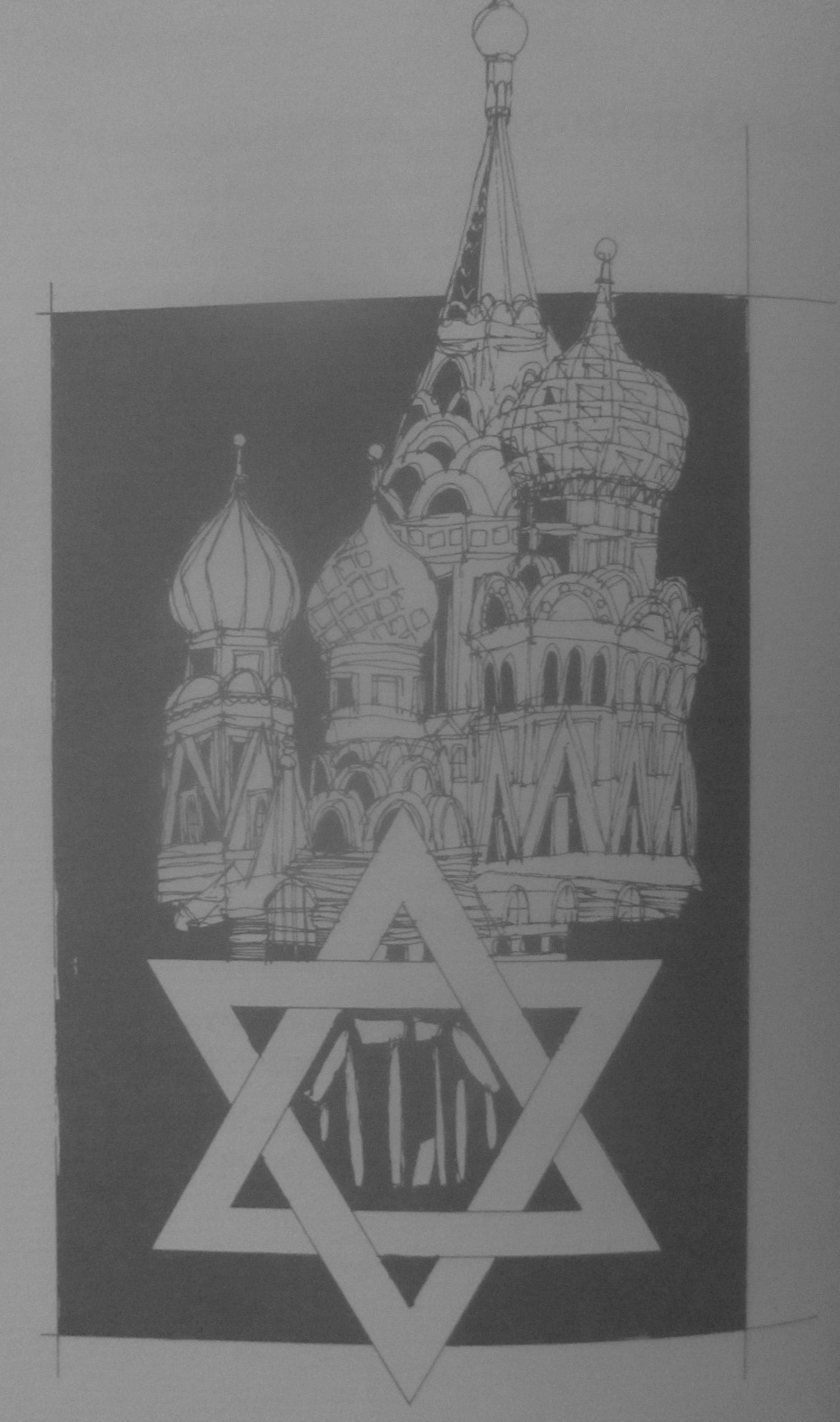
As might be expected given Stern’s talk, the Freedom Haggadah included novel illustrations:

ImageMark Podwal, 1972 (footnote 4)

Though similar to the Haggadot of earlier periods, it also represented a fundamental shift in Jewish imagination. Time still collapses, to be sure, but the bearers and readers of the Haggadah are no longer included amongst those who need redemption – amongst those pictured in the Haggadah and projected back upon history. Rather, American Jews overlaid the Israelite struggle with images of contemporary Soviet Jewry. This implies that they understood themselves to have been – at least partially – redeemed and liberated, living the good life in democratic-capitalist and Zionist America, with access to Israel.

Indeed, they may not have been the first generation of Jews to feel this way. Professor Stern showed us modernist illustrations from an interwar German Haggadah, the aesthetics of which – in my opinion – offered testimony to a strong feeling among German Jews that they had been fully integrated into German society and culture. It evoked comfort in the present moment, rather than suffering, slavery, and exile therein.

What happened next? Where are we today?

The Soviet Union collapsed and one-million Soviet Jews immigrated to Israel between 1989 and 2003 (Footnote 4). Shaul Kelner writes,

Within a decade of the movement’s end, observers of American Jewish life were already speaking of a populace less inclined to locate meaning in the politics of redemption, and of a communal leadership focused not on unity in the face of external threats but on factional conflicts and fears of dissolution from within (footnote 5).

There are still plenty of creative Haggadot, with roots in the same period – and politics – as the Freedom Haggadah. During those same decades and still today, American Jews composed and continue to publish Haggadot for Jewish feminists, the LGBTQ community, alcoholics, and others. These reflect, in the words of Deborah Dash Moore,

… the growth of liberation movements… that emphasized a kind of narcissistic individualism [that] threatened the very concept of communal responsibility uniting Jews throughout the world (footnote 6)…

To be clear, I support these movements and don’t understand this trend exactly as Moore describes it. (And, even if I did, perhaps “individualist” would have been a better turn of phrase than “narcissist,” with all of its negative connotations.) [Note: I am better acquainted now with Moore’s work and have realized that we likely share more in terms of perspective than I understood at the time that I wrote this. JL, 2020.] Responsible community construction can never be completed if it is achieved at the expense or exclusion of community members. Moreover, the experiences of alienated individuals and groups can be used to create more inclusive and meaningful narratives and practices for the entire community of which they are and should be a part. Moreover, many find tremendous strength in these reconceived rituals. They enrich us all, regardless of our subject positions. (To be clear, I have no idea how Moore feels about this phenomenon and do not expect that she thinks of it poorly. This is merely a statement of my own perspective.)

Other new Haggadot address more universalist concerns, like global hunger and the environment, or focus on particular political issues like the Israeli-Palestinian conflict or Darfur. (See the Reform Movement’s Religious Action Committee for downloads.)

What is missing, however, is the projection upon the ancient past of a totalizing, yet locally focused, picture of contemporary Jewry. (In other words, what is missing is the imagination, not only of the Jewish past, but also the Jewish present in terms of a specific community, its concerns, and its needs.) The process started during the Cold War, when American Jews imagined themselves to have been already redeemed and thus responsible for the liberation of other Jews. Now that Soviet Jewry no longer occupies our minds, we seem to have lost our ability to collapse time and, with it, an important part of our historical imagination.

This brings me to the last set of Haggadot that I will address. Contemporary authors have blessed us – literally and figuratively – in recent decades with scholarly Haggadot that draw upon centuries of texts and traditions. We might call them “historiographical Haggadot.” (See the Schechter Haggadah for an example of excellence in this regard.) They contain pictures and commentary from an array of sources that teach us about how other Jews in other places and at other times projected themselves upon the Passover story. It is as if they ask their reader to

look upon himself as though he were a Jew of another era looking upon himself “as though he went out of Egypt.”

These Haggadot call upon us to tour through the Jewish historical experience, to take upon ourselves the guise of Tevyeh the Milkman or Don Isaac Abravanel, but they do not call us by name, nor do they ask us to identify ourselves. This brings to mind the warning issued by Yosef Hayim Yerushalmi in the conclusion to his revolutionary work, Zakhor: Jewish History and Jewish Memory:

The decline of Jewish collective memory in modern times is only a symptom of the unraveling of that common network of belief and praxis through whose mechanisms, some of which we have examined, the past was once made present. Therein lies the root of the malady. Ultimately Jewish memory cannot be “healed” unless the group itself finds healing, unless its wholeness is restored or rejuvenated. But for the wounds inflicted upon Jewish life by the disintegrative blows of the last two hundred years the historian seems at best a pathologist, hardly a physician (footnote 7).

Unfortunately for you, who have indulged me thus far, I am only an apprentice historian – a junior pathologist of memory at best.

Personally, I embrace this historiographical and “narcissistic” turn. I welcome it as an invitation to play seriously and self-critically with tradition – and to find within it pluralities and modalities that resonate, if only fleetingly, with the concerns of the day. Rather than collapsing all of Jewish history and transcending time by casting it in our own image, we unfold ourselves across two millennia of Jewish historical imagination. And we claim with this move the right to invest our activism with holiness – however conceived – and the strength to fight our personal struggles in the company of fellows both present and long vanished.

To those who fear that this a transition of  Jewish historical memory threatens to undermine Jewish “peoplehood,” I first remind you that I am merely a junior pathologist of history. I can offer no remedy to stop the flow of time nor wrest our communities from the gravity of broader cultural processes. I hope, though, to offer you solace and perspective.

I perceive tremendous potential in our new historical practices for momentarily experiencing the tribal – for “seiz[ing] hold of a memory as it flashed up at a moment of danger (footnote 8)” and bending it towards ourselves. We can celebrate our communion in time and tremble together at our shared concerns for the future – in moments of prolonged intentionality. Yet we can also choose to travel lightly through these practices of peoplehood, without attributing to them political imperatives – without succumbing to the temptation to perceive ourselves as a chosen singularity at the expense of (or worse, set against) “others,” both internal and external.

I admit that this is a difficult challenge, even for those among us who embrace it. And we don’t understand ourselves fully yet. We are a hyperlinked generation – each of us with our own unique and ever-changing arrays of connections across history, communities, genders, and religions. Managing such selves and the communities we create with them requires hard work, dedication, and education. But just try to take from us our networking devices! Tevyeh will not find a comfortable place in our midst and in our time. Yet evolution does not happen because things stay the same. The brave bearers of today’s mutation will survive to lead longer and fuller lives in a more interesting tomorrow.

And so, I turn to you. How will you “see yourself” this year “as though you went out of Egypt?” Will you be in the company of the Jewish people? Or will you find redemption and freedom alongside a different cohort (or sub-set) of people, with all of humanity, or with the environment?

Chag sameah.

Footnotes:

1) http://www.nytimes.com/2011/04/09/nyregion/09haggadah.html?_r=0

2) Shaul Kelner, “Ritualized Protest and Redemptive Politics: Cultural Consequences of the American Mobilization to Free Soviet Jewry,” Jewish Social Studies: History, Culture, Society, n.s. 14, no. 3 (Súring/Summer 2008): 11.

3) http://www.jewishvirtuallibrary.org/jsource/Immigration/immigration.html

4) Let My People Go Haggada, 1972.

5) Kelner, 30.

6) Deborah Dash Moore, B’Nai B’rith and the Challenge of Ethnic Leadership (NY: SUNY Press, 1981), 249.

7) Yosef Hayim Yerushalmi, Zakhor: Jewish Memory and Jewish History (Seattle: University of Washington Press, 1982), 94.

8) Walter Benjamin, “On the Concept of History,” http://www.sfu.ca/~andrewf/CONCEPT2.html

Posted in Uncategorized | 3 Comments

Welcome

Hi all,

Please stand by while I work on this blog. It is intended to be a platform for me to share my thoughts and engage with you. It will take some time for me to learn how to use this software, so please be patient. I still use a rotary cell phone and the 2.0 revolution has been cruel to me.

Posted in Uncategorized | 1 Comment